I have a Audio innovations 1st audio that used 8 pin 2a3 which have stopped working,does anyone know if i can use 6b4g instead.As it would be nice to have it working again to ether sell or use in a 2nd set up.
You need to convert it for the different voltage I think, but I don’t think it’s that hard. I’m sure any competent valve repair person could do it.
This. It’s conceptually straightforward but not trivial in practice. Each 2A3 has an independent filament supply whose voltage (2.5V) is set by a winding on the mains transformer. You’d need four separate 6.3V supplies if you wanted to use 6B4Gs. That would almost certainly require the fitting of one or more additional transformers (or perhaps off-the-shelf 6V switch-mode supplies, if you could live with those).
Paul’s adaptors sound like a better idea. Or just replace the octal sockets with UX4 ones.
VB
Worth checking with PM components to see if they have any matched pairs of octal 2A3 but if not then do as Graeme suggests and change to UX4 bases. It isn’t that big a job. The reason AI switched to 2A3 was because the readily available supplies of US made 6B4Gs dried up. This was 1988 and there was no way to access Russian stocks of their ex military valves at that time. The Chinese had started to make 2A3 by then but there were no 4 pin sockets being made. Octal sockets were commonplace so it made sense to ask the Chinese for an 8 pin version of the 2A3. UX4 sockets began to appear again soon afterwards and AI then switched to using conventional 4pin 2A3s. Communication and acquiring components from around the globe presented very different challenges in the late 80s.
I asked PM components a few yrs ago no luck.Saw some on e-bay about a yr ago but they were asking for £2,000 for 4 and would not take a offer.It does make sense to change the sockets but i do not know how to wire it as there are more than 4 wires.Just seen 3 for sale on e-bay but they have a strange code (2A3 Lc9).
Thanks for the link might be the way to go.
Can you post a pic of the view from beneath? I suspect that if another pin on the octal base is being used it’s just being a handy non connected tag point and won’t be connected to any of the four live pins on the base of the 2A3.
There are some before and after pics here but I can’t find any explanation
http://www.acoustic-dimension.com/tube%20modifications/firstmod.htm
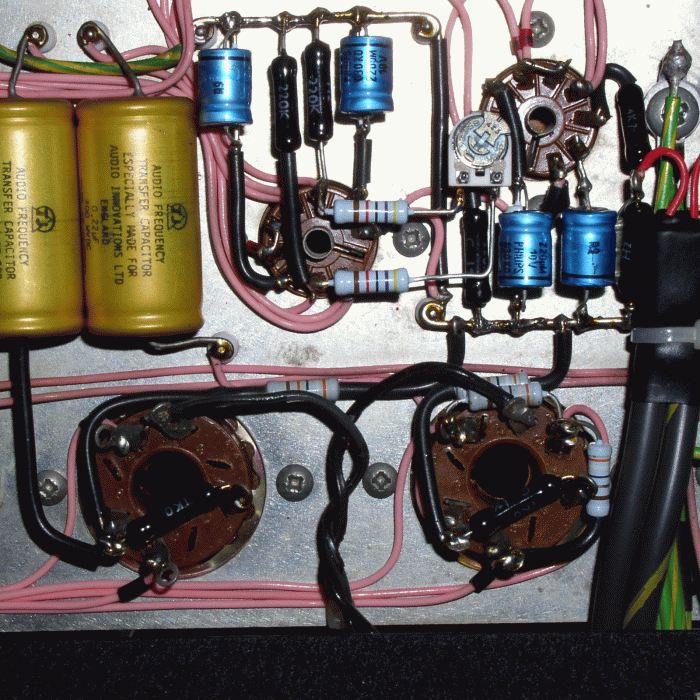
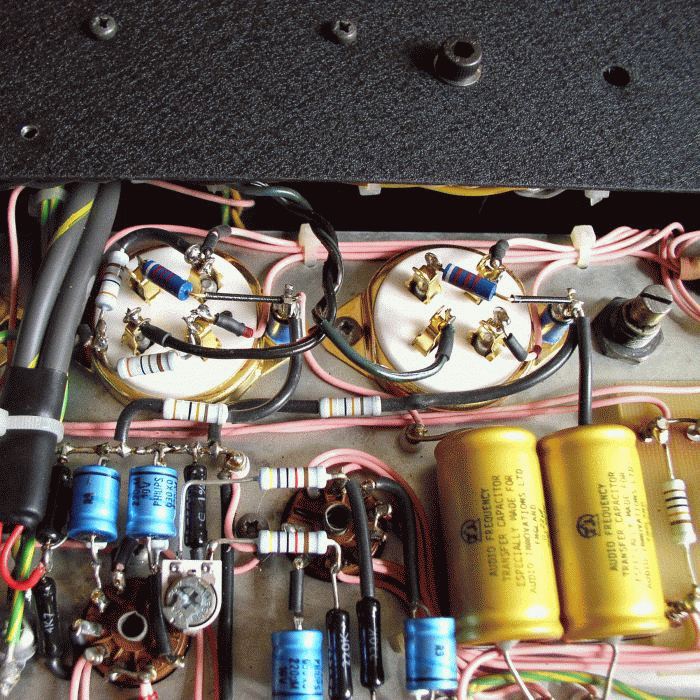
(not of pinkfish’s actual amp, obvs)
VB
I have the schematic at home. I did do this conversion for someone years ago and seem to recall it being fairly straightforward.
Online here, depending on which version it is
VB


Should be ok. I’m out today but will have a look later
1 Like
I recently sent the 1st audio away to have the 2a3 sockets changed to 4 pin ones while it was there most of the caps got replaced and the bridge rectifers were replaced as well and a choke filter to the power supply, after a lot of messing around with parcelforce it came back last week and one of the new 2a3s was damaged in transit but i turned it on anyway minus the dud valve but i’m only getting sound from the right side. Any ideas as to why anyone.
You should be getting a bit of crappy, distorted output from the side missing a valve. You could try putting the functioning pair in that other channel & the single valve on the other side. See if that channel will produce output with a pair of valves installed.
1 Like
I see Guy’s replying and he will know better than I do. But can you see if the filament in the remaining left channel valve is lighting up ? Tungsten filaments tend to go brittle with age and if the amp’s been banged hard enough to damage one valve then it may be that the filament in the other one has gone open circuit.
If neither 2A3 is working then the power supply voltage may be scarily high. I wouldn’t run like that for long (if at all, TBH).
EDIT. Just seen your reply to Guy, so my filament guess was wrong.
1 Like
Done that still the same.
Could it be the cathode resistor or the coupling capacitor?
It could be almost anything. Do you have reason to suspect those ?
They’d have to fail open circuit and capacitors only tend to do that if the wire’s snapped off or a solder joint to the cap has failed. Resistors can be blown o/c but again it’s rare without a lot of smoke. Again though, snapped wire, failed solder joint …
Is the dead channel utterly silent or is there any trace of hum/hiss, even at full volume ? If you have an ohmeter then with the amp turned off and the speaker disconnected is the resistance between the speaker terminals very low i.e. less than an ohm (it should be) ? Could it be the speaker or its lead (try swapping the connections over at the amp) ?
Because that’s what the man who did the work said try, it’s not the leads cause i can slot a 1st watt j2 in and it works fine. No hiss or hum will try checking resistance on the speaker terminals later. I think at the end of the day i need to think about sending it of for someone to look at.
Thanks for your advice.