Referring back to the helping hands device I bought from Amazon, I’d say it served its purpose well for the money.
But I did find myself wishing for an extra hand that could apply light pressure to each wire so that it would glide gracefully into the pin as the solder melted.
Then it occurred to me that what I actually needed was a miniature AI-driven robot octopus. That would be an overcomplication, of course, so maybe just an ordinary octopus (well-trained and with heat-resistant tentacles).
Of course, if Superman is any good at soldering (he has the powers, but does he have the precision?), he’s a shoe-in for my next soldering gig. Anything to avoid going through that palaver again…
Or otherwise just cut the pain nerves and it’ll be able to hold way-too-hot things without ever realising or, at least, until the smell of fried octopus gives the game away of course. Guess how I know this (and no, the cut digit didn’t belong to anyone/anything else).
OK, I’ll take a guess (I don’t pay enough attention to what goes on here - or anywhere else these days, so if you’ve already told this story, I haven’t seen it).
I’m going with an injury to your hand which rendered it (temporarily, I hope) insensitive to pain, leading to a solder burn which could have been avoided had your natural pain sensitivity delivered the usual ‘fuck me, that’s hot’ signals.
Oh, and while I’m at it, a couple of things I learned form my recent solder bodgery:
There are things you expect to get hot, but they get much hotter, much faster than you expect.
There are other things you think may get hot, but you aren’t sure how hot or how quickly. Those things also get much hotter, much more quickly than you thought they would.
Some of the things you expected to get hot, but expected to cool own quite quickly due to their size and proximity to the heat source, stay hot for much longer than seems logical (ouch). This applies especially to the tiny pins on an XLR plug. Kudos to Neutrik for that plastic pin holder, which absorbs a huge amount of heat without melting, only to keep those damned pins at solar temperatures for an unreasonably long time (ouch, again).
It’s 2024 - surely about time that technology moves on from joining electronic components using heat and toxic metal (even I now know that lead free solder is shit). I mean really, for fuck’s sake…Is there genuinely no alternative?
Spot on, except for ‘temporarily’. No sensation up the outside of my right index finger and given that it was years ago it probably won’t come back now. Shame. Of all my fingers that one was my favourite.
Wire wrap and crimping both spring to mind. Each needs a particular tool though and can be hard to implement on a very small scale or in a tight space.
When it comes to mounting components most modern commercially produced stuff is surface-mount these days (still soldered though). I know people with sufficiently steady hands that they can do that manually ! I even managed it myself once.
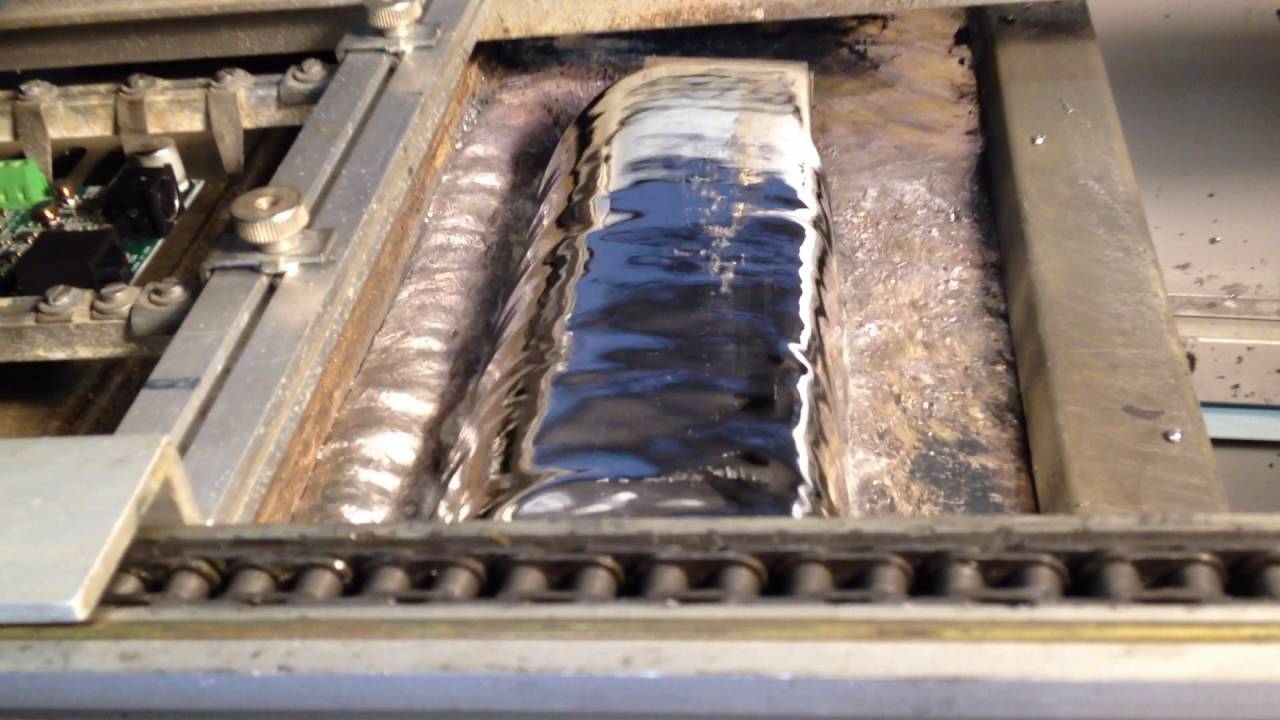
Of course you could get yourself a wave-solder rig
Probably best to try to find one that doesn’t play that dreadful plinky-plonky music all the time though.
As an act of profound masochism - and final proof that I don’t really have steady-enough hands for SMD - I once built a very simple phono stage with just surface-mount components and bare 0.3mm silver wire onto perfboard and using unleaded silver solder - the clumpiest-of-the-clumpy. To my astonishment, it worked, tho’ for reasons I couldn’t be arsed to ascertain, had a lot of 50hz breakthrough from the PSU. It is one of many, many things in The Cupboard Of Shame…
I was thinking more along the lines of some kind of push-fit alternative, but I should have guessed the answer was much closer to the ‘ridiculous faff, space and expense’ end of the spectrum…
Electrically-conductive adhesives exist and can be used for PCB assembly, but are unlikely to be as reliably conductive as solder, and not much use for high current or high voltage applications.
If you’re talking about making-up leads, well there are screwed/clamped alternatives for many of those, albeit the plugs are not aways easy to find, e.g. ViaBlue used to offer RCA plugs with screw-down connectors, but I’m unsure if they still do.
Crimping is widespread in lead-making, as it makes manufacture easier / automate-able, and arguably gives more reliable contact integrity. Its biggest downside for home use is you need a LOT of different dies if you want to be able to use different cables and plugs, and good quality crimps and dies are fierce-expensive!
Spot-welding, including ultrasonic and laser welding is used in manufacture, but not much application for the casual DIYer!
Before The Great Reset there used to be a picture on here showing what someone who knew what he was doing (not me) could achieve with croc clips. It was a glory to behold but a bit tricky to move while plugged in I imagine.