Good to hear.
Tried the tapped horns in all possible orientations when we moved in, and more recently with them across the far wall.
Room overload at that volume and inputs  , I think.
Good to hear.
Tried the tapped horns in all possible orientations when we moved in, and more recently with them across the far wall.
Room overload at that volume and inputs , I think.
Plumbed in the Eminence Definimax 4012, 12" TH driver this afternoon.
Out with the Lab12
I needed longer M5 bolts. Didn’t have enough.
Had some spare larger threaded bar..
Whizzed it down on my Minilathe and threaded it.
Therapeutic a bit of metalwork!
In with the Definimax.
Set up the measuring rig.
Lappy/WaveIO to Najda and Behringer power amp. Mic etc.
Nice just sub 30Hz to 60Hz. Currently the XO is 25Hz to 60Hz 4th order high and low pass.
This is with no PEQ.
The Don Sunder 30Hz Tapped Horn was designed for this very driver!
On the other amp channel, I connected up the Lab 12, just to watch it boogie.
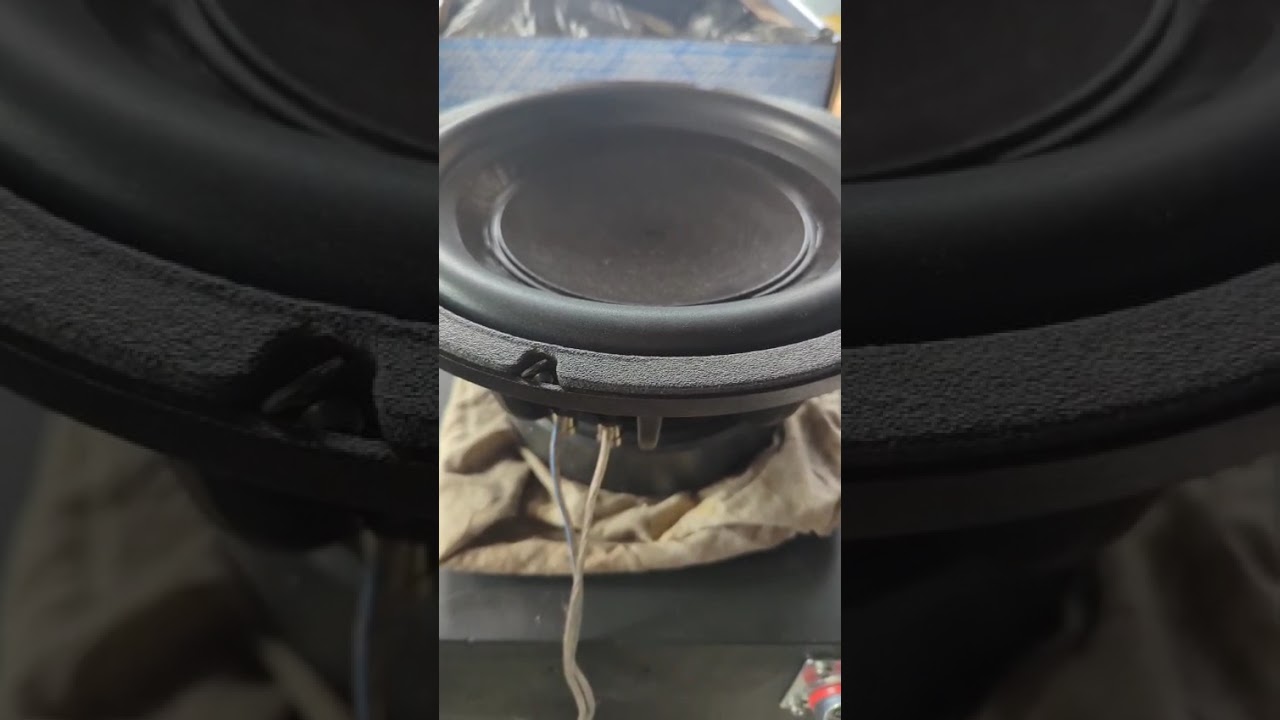
Next to make that boom box enclosure for it, and test.
Plywood I think with bitumen damping of course.. @Ruprecht
Steve it’s only since visiting you that I have started to understand ( i think) exactly how a person can build one. My understanding is 
Inner flare - four trapizoids moslty 90 degree cuts glued together to give 50 or 60 degree flare.
Outer Flare four trapiziods glued as a skirt with a small bit of compound angle .
that sits atop the inner flare
Inner Flare and Outer Flare are then glued and radiused.
Bracing pieces then added to inner outer flare
Outer chamber -Long compound angles - not sure I have fully understood how it connects to the inner bits. Looks faffy
I think that the box is awkward but hey, filler is your friend. You could cut everything with 90 degree angles and as long as your bracer pieces are done well, it’ll be solid enough to fill.
What I don’t understand is the placement of the holes for the throats. Is there a guide to this, or is it just a matter of fucking about in Hornresp for ages?
I’m thinking of creating a MEH using drivers I already have. There would be a single driver per frequency each side; is the use of two mid bass drivers per side mainly for SPL, or is there a technical reason for it?
Should help with the design side
This is the other popular design similar to the JMOD but different porting
Cheers Dom - Just what I needed
No problem, and finally this is the pair I am making at a near Rabski speed
It has a 3D printed throat optimised through some extensive AI modelling.
My daughters boyfriend has access to very large 3d printing So i am eyeing that type up for a future build
thanks steve for this upload

Yep cheers spotted that that’s what i was thinking as a second effort
And portable, on some of his stories he has two of those running off a large rechargeable battery pack, like the ones they sell for camping
If you go old school (wood) there are pyramid angle calcs that give you the compound angles for a nice fit.
Evostick urethane wood glue is great.
Makes construction much faster and more solid than PVA etc.
Getting the throat right from square to round is where I’ve seen some struggle.
I’ve found a nice progression (more than just filling the first bit of the corners in), makes for top sound.
Essentially you are making a wave guide.
That takes care and time.
I didn’t go anywhere near hornresp in the end. Too involved.
The Danley patent states 1/4 wavelength distances between the drivers, although as close together as poss. works fine too.
The tap and port sizes and distances are all out there, if you look.
The patent essentially has all you need to know, apart from the mysterious/complicated analogue XO..
DSP is your friend.
Multi drivers are for SPL.
I started out with 1 x 12" LF and 2 X 5" MF.
1 X 5" would probably be fine.
I just halved what Danley used.
Worked fine. Just throttle the compression driver more.
Outside use, the LF needs lots of SPL and power.
Yeah I have a sliding mitre saw, which I think would be big enough and mean I could do the angles. Not entirely sure on size though!
I’ll try reading the patent. The 1/4 wavelength point is interesting. I would expect to 3d print the throat adapter and do everything crossover in digital.
Thinking time. Lots of thinking time…


