That’s fab Al - 8k quoted but estimate sale of 2.5-4K - not sure how that works.
More reminds me of early Winter.
Really love this.
Assumptions are invidious - and can be fatal - yet I am one of their most industrious makers…
When I was a kid, a visit to some minor stately home in Dorset (I had to drag my parents to such places, rather than the usual order of things), bought the beautiful, breathtaking wood-carving of Grinling Gibbons (flourished l. C17th; won at Names forever) to my attention.
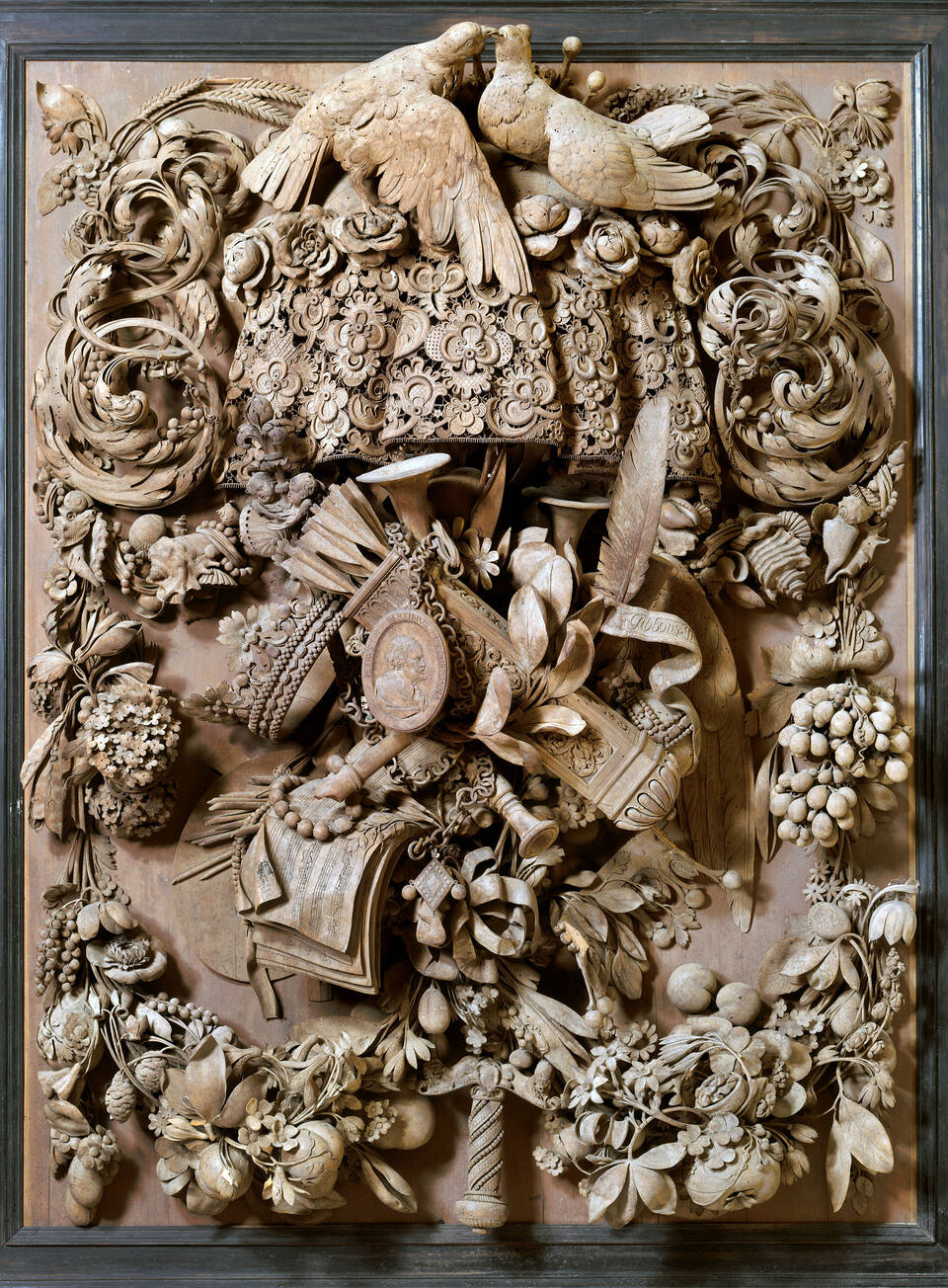
{ ^ This is not that, but the ‘Cosimo Panel’ - a gift from Charles II to Cosimo Medici. }
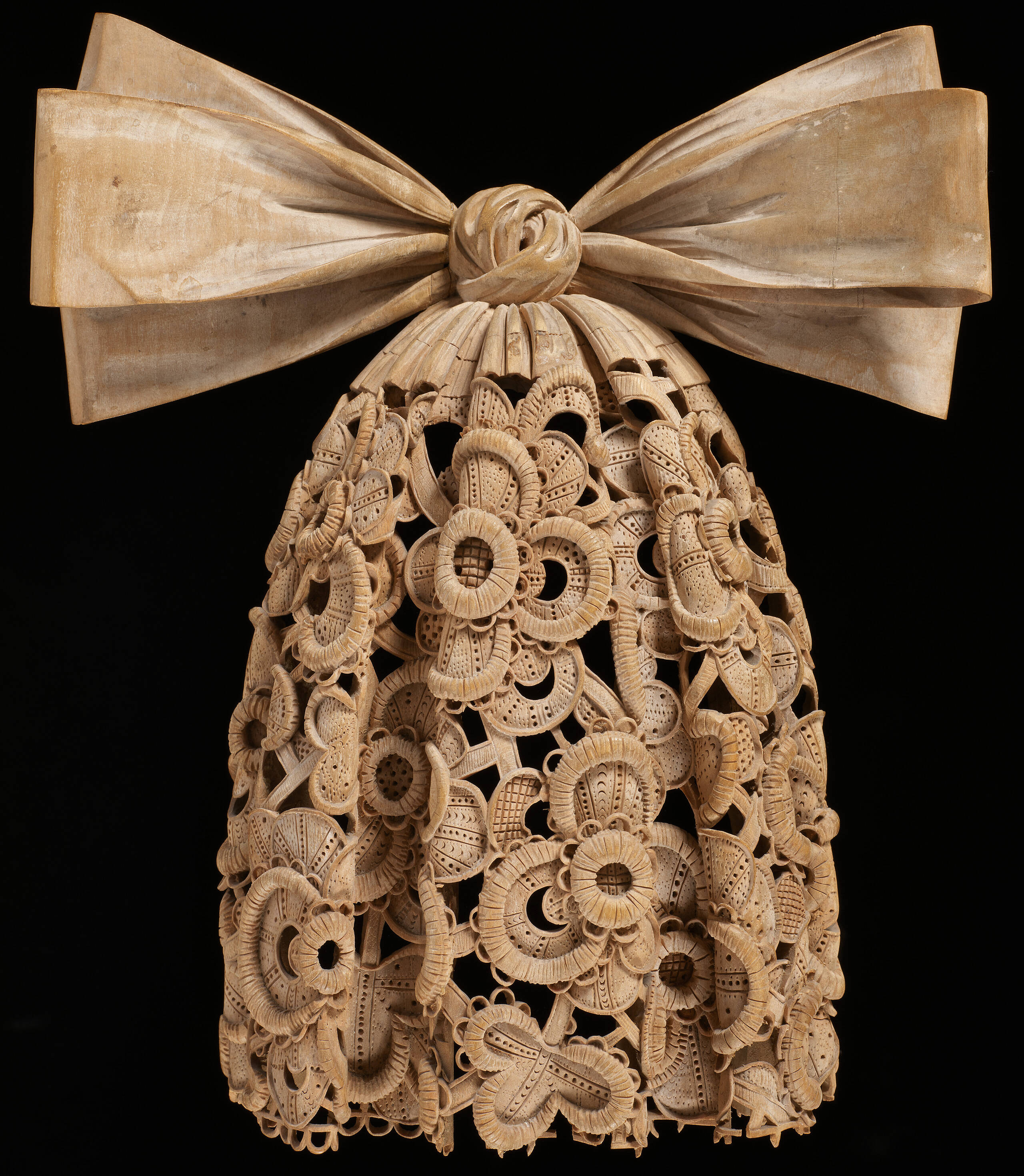
I was utterly blown away at what one spectacularly talented man with a sharp bit of steel and a lump of pearwood could achieve. The breathtaking delicacy of individual flower petals, the intricate detail of feathers, the texture, ‘hang’ and reticulation of lace, the lifelike geometry of exotic seashells… So perfectly captured, that I now realise that a large and stupid assumption was made by young me, and carried onward to pre-dotage: that somehow this art came out of nowhere (rather than the Dutch ‘schools’ of such things plus the tastes of the time), and died with him - which it assuredly did not, though he was a game-raiser for sure…
Today I stumbled across one of the later inheritors of Gibbons’ mantle - C19th Lincolnshire artist, Thomas Wilkinson Wallis. He had a quite different background, being born into poverty, uneducated until early adulthood, and even working in a quite different way.
Gibbons cleverly structured his work in layers designed to build into a single edifice (his father may have been an architect who worked with Inigo Jones, so perhaps some influence from there), but Wallis was more of a purist/masochist - making clay models first and then carving the entire piece from a single block of (usually) lime.
Wallis’ work is, admittedly, more vernacular in scope than Gibbons’, and very much to the morbid tastes of Victorian society - often featuring dead game, but it is also fabulously well-wrought and naturalistic:
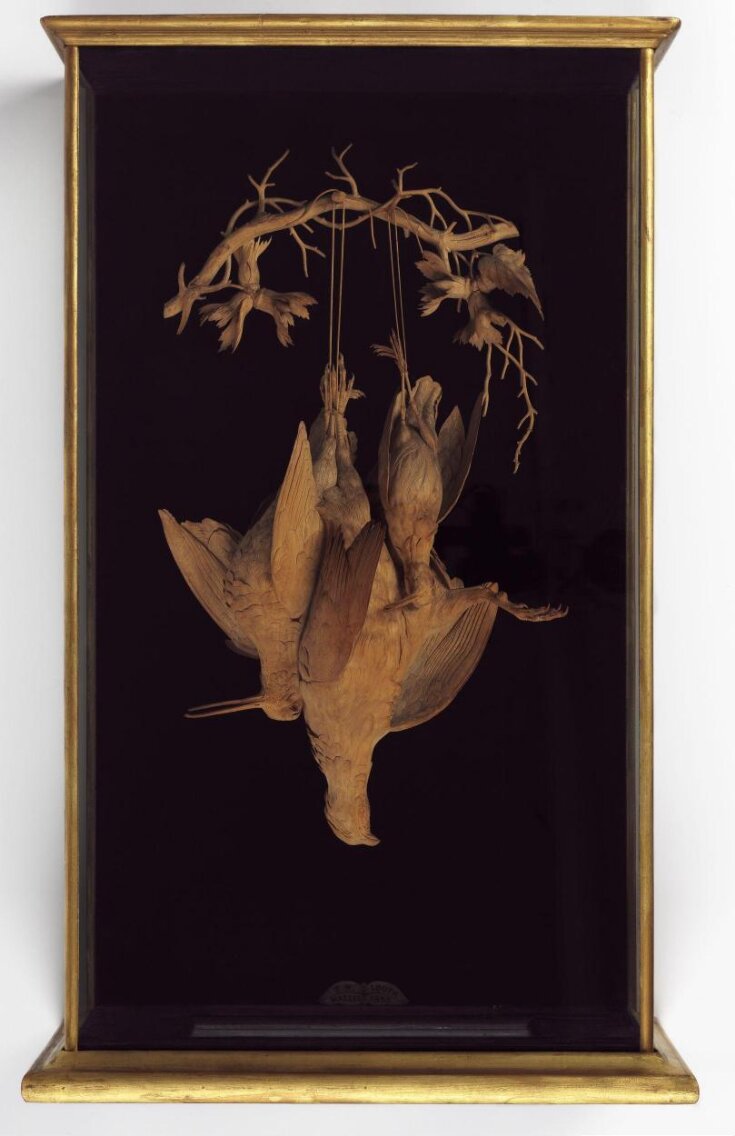


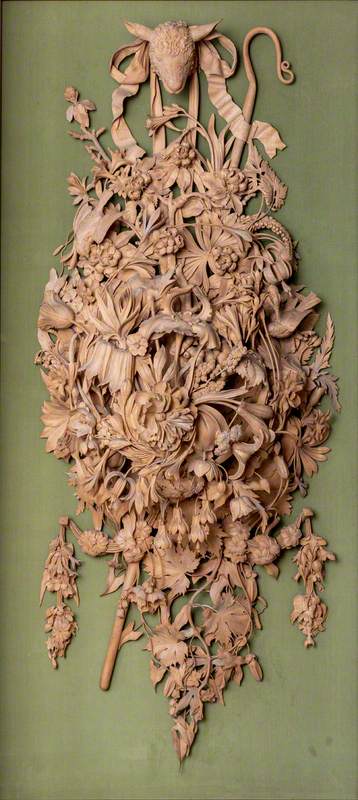

Just one name of many who’ve worked (and still very much do) in this field. Such talents truly astound me (who cannot make a competent mortice-and-tenon joint)… 
11 Likes
I’m sure you’ve been, but just in case you haven’t, Burghley House has some Gibbons. Lincs Education Authority used to take busloads of primary schoolers across to see it (and to see their other stuff). I remember his trademark peapods to this day (very much a feature of real local life of course).
They also have one of those dead birds hanging by a thread, this one by Demontreuil

1 Like
Nice one  Perhaps unsurprisingly Louth Museum has some of Wallis’ work, too.

I shall be travelling up for this. For the art & to see/hear Laurence Passera’s Western Electric and Klangfilm rigs providing the musical accompaniment. @Ruprecht tipped me off about it some months ago, maybe one of his decks will be in use.
9 Likes
Thanks for this, I can see me and nephew trekking down for this too.
I’ve been to Laurence’s place in Silvertown. He’s accumulated an impressive collection of WE & other gear dug out of various crumbling fleapits. There also appears to be some appealing guest DJ’s doing sessions there during the residency.
To me this show is attempting something special. It is melding two forms of art. When you consider a gallery exhibition the viewers come into the space with a reverence a sensitivity and take from it what they will - the same can be done with sound but this is not often an option for the wider public. - sure there are listening bars etc but these do not conjure an experience they are often just theatre, an angle, a usp. There is something very cool about opening sounds door to the art world. It has legs (exhibitions travel etc). The klangfilm system isn’t just any old thing - it was Florian’s. The WE rig isn’t just any old rig either - NB this is not Hifi but if you’re into scarcity, art, and up for an experience this will be a thing - lots more info to come on this as things firm up
6 Likes
My newest addition. One I found quite by chance. It’s an original proof print by Eduardo Paolozzi. It’s been away for four weeks at the framers and just picked it up today.


14 Likes

Looks very cool, be careful of fading, looks like plenty of sun in that position.
1 Like
It’s east facing with another set of flats across the road, so not quite as much sun as you’d think. A few hours in the morning of direct sun and then it’s just indirect. Sadly is only place for it to go
1 Like
You can get the framer to fit UV-blocking glass which is supposed to help a good deal. Perhaps worth talking to the framer about the pros and cons ? That said, it may be that your window glass is already doing some of that. I know a bit about UV but essentially nothing about pigment fading.
We had UV glass fitted on a couple of pieces. The only downside I can think of is cost. Cheap it was not, but that might have been the framers adding their slice too.
Two layers of glass on a fairly shady east window in Scotland. I suspect it’ll survive 
Forgot you were that far north, the light in that photo is probably the most it will see in an average year 
1 Like
